
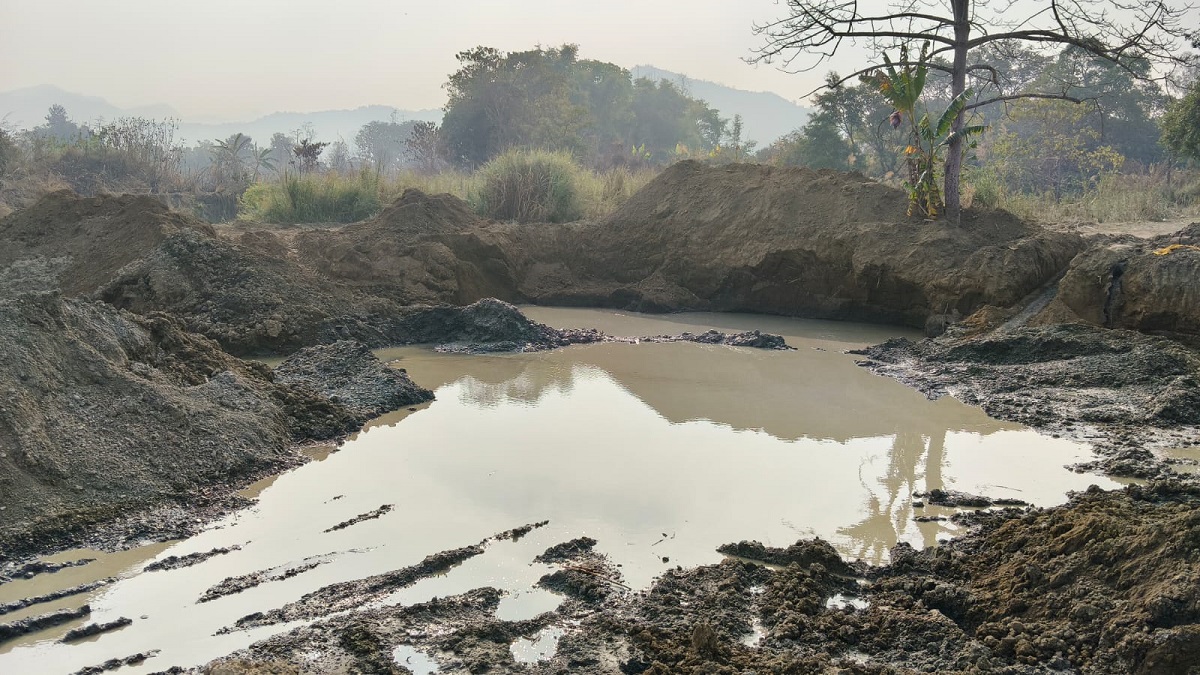
Water is one of the most essential natural resources for human survival and forms the backbone of civilization. Among natural resources, rivers play a vital role not only in sustaining human life but also in maintaining ecological balance. In Manipur, due to the prolonged dry season and inadequate rainfall, many people are already facing acute water scarcity. In Kakching, the Sengmai River, which serves as a major source of water for the local population, is reportedly being subjected to excessive sand and stone extraction using heavy machinery, causing serious environmental and public concerns. In connection with this issue, a team led by the President of the Joint Non-Government Voluntary Organization (JNGVO), Kakching, Kshetrimayum Chhatradhari, along with the caretaker Chairperson of the Kakching Municipal Council, Naorem Sanjitkumar, conducted an inspection at various points along the riverbank. During the inspection, it was observed that from Naoriya Paat up to Pallel, several locations along the river were being excavated using JCB machines to extract sand and stones, allegedly in violation of existing laws. In some areas, individuals were seen manually breaking and removing boulders and stones with the help of machines. Such large-scale extraction has reportedly altered the natural flow and structure of the river, adversely affecting its strength and ecological stability.
Speaking on the matter, JNGVO President Kshetrimayum Chhatradhari stated that the use of heavy machinery for sand and boulder extraction is causing significant damage not only to the river’s natural course but also to the overall ecological balance. During the dry season, the river’s water level is already low, and indiscriminate extraction further disrupts the riverbed, leading to depletion of water retention capacity. As a result, water that should naturally accumulate and flow downstream is being obstructed or diverted, affecting residents in downstream areas, particularly those in the Maninglom and Wabagai regions of Kakching who depend on the river for daily use.
JNGVO has urged the Forest Department and other concerned authorities to take immediate and stringent action. The organization also appealed to the Kakching District Administration to conduct a thorough investigation and requested the Police Department to take strict action against those involved in illegal activities. While acknowledging that stone extraction may be carried out by some individuals for livelihood purposes, the organisation emphasized that the welfare of a few should not come at the cost of hardship and suffering for the larger community. It appealed to the public to refrain from activities that harm the river and create difficulties for fellow citizens.
In a related statement, the President of the Unapal Sporting Union, Ch. Chomrei, expressed concern that although the Sengmai River had been a reliable source of water for many years, its water has recently become unusable in several areas due to excessive extraction activities. At present, residents are reportedly relying on private water supply sources to meet their needs. Despite the existence of various environmental and ecological protection laws, questions have been raised about whether the relevant authorities are effectively implementing these regulations. In particular, concerns were expressed over whether the Sustainable Sand Mining Management Guidelines, 2016, issued by the Ministry of Environment, Forest and Climate Change, are being properly enforced in the area. The organizations reiterated their demand for strict enforcement of environmental laws to protect the Sengmai River and ensure sustainable use of natural resources for future generations. inspection at various points along the riverbank.