
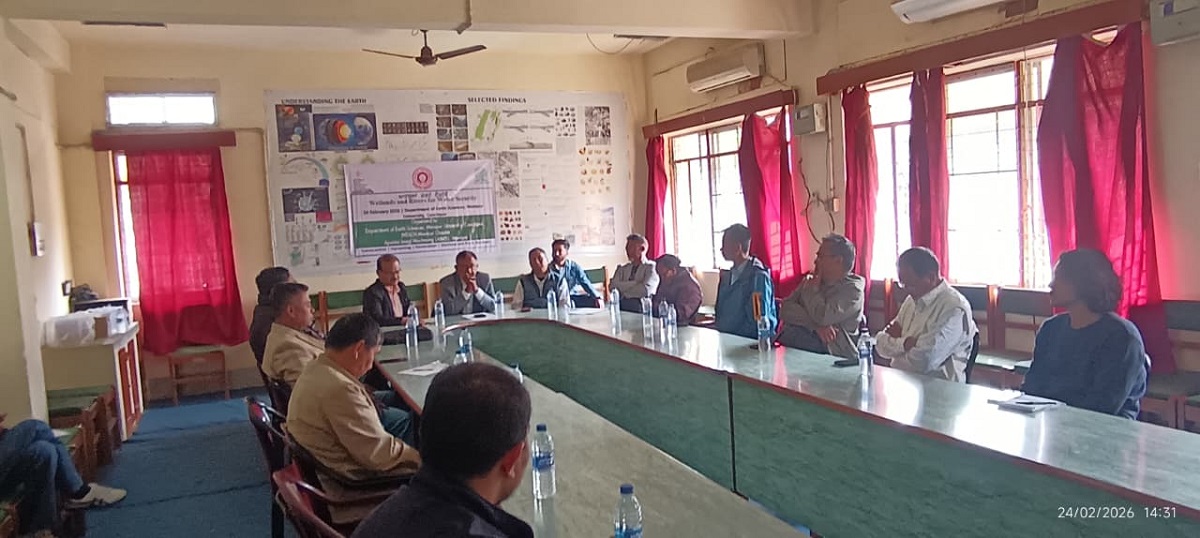
A panel discussion titled “Wetlands and Rivers for Water Security” was held at Manipur University in Canchipur, organized by the Department of Earth Sciences in partnership with the INTACH Manipur Chapter and Apunba Imagi Machasing (AIMS). The event featured esteemed experts, including Dr. RK Ranjan Singh, former Minister of State for External Affairs and Higher Education, and Prof. Huidrom Birkumar Singh, Chief Scientist at CSIR NEIST Manipur, alongside academics from the host department and other notable figures like Dr. RK Chingkhei and AIMS Director Dr. Atom Sunil.
The consensus among panelists and attendees was that Manipur faces acute water insecurity, primarily driven by human activities such as deforestation for agriculture, illegal logging, and poppy cultivation. These activities, coupled with unregulated sand mining and rapid urbanization, exacerbate the water scarcity crisis. Additionally, natural factors such as the state’s geomorphology, which limits water retention in hills, alongside river and wetland siltation, further undermine water supply, with climate change also contributing significantly.
The discussion underscored the importance of wetlands and rivers in ensuring water security in Manipur, prompting a call for a comprehensive scientific study of these ecosystems. This study aims to develop a detailed database highlighting vulnerabilities and strengths related to local water resources. Future discussions should focus on specific wetlands and rivers to accurately identify causes of water insecurity and develop targeted mitigation strategies.
Attendees emphasized the need to address constitutional oversights and institutional discrepancies that hinder effective water management and urged the government to review environmental policies. This includes clarifying regulations on sand mining, stopping illegal deforestation and poppy cultivation, and enforcing compliance.
Collaboration between event organizers and government departments is essential for future discussions to ensure that the study’s findings are systematically compiled and presented to the Government of Manipur as formal policy recommendations for addressing water security challenges in the region.