
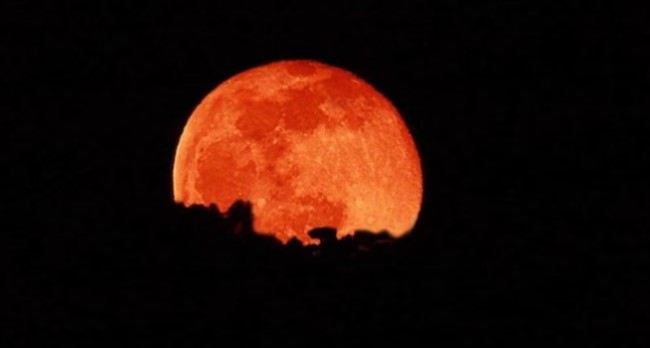
The arrival of the first lunar eclipse of 2026 has sparked a wave of excitement among skywatchers and cultural enthusiasts alike. Scientifically known as a total lunar eclipse, this celestial event occurs when the Earth positions itself directly between the Sun and the Moon, casting its deep shadow, or umbra, over the lunar surface. The most striking feature of this phenomenon is the “Blood Moon” effect, where the Moon takes on a dramatic reddish hue. This happens due to a process called Rayleigh scattering—the same reason sunsets are red. As sunlight passes through the Earth’s atmosphere, the shorter blue wavelengths are filtered out, while the longer red wavelengths are bent toward the Moon, illuminating it in a hauntingly beautiful glow. Astronomers emphasize that unlike solar eclipses, this lunar event is perfectly safe to view with the naked eye, offering a brilliant display of celestial mechanics.
Beyond the scientific explanation, the Blood Moon has been a central figure in human folklore and mythology for millennia. In many ancient cultures, a reddened moon was seen as a powerful omen. Some traditions viewed it as a sign of impending change or a disruption in the natural order, while others believed the Moon was being attacked by celestial creatures. For instance, in certain Mesopotamian myths, the eclipse was interpreted as an assault on the king, whereas in some indigenous cultures, it was seen as a time for the Moon to heal and rest. Even today, many people follow traditional beliefs, such as avoiding food during the eclipse or practicing meditation, viewing the event as a period of intense spiritual energy and internal reflection.
Modern-day science and ancient beliefs often converge during these events, as the eclipse provides a rare moment for humanity to look upward and contemplate our place in the universe. While researchers use the opportunity to study the Earth’s atmospheric composition by analyzing the light reflected off the Moon, millions of others find personal meaning in the transition from light to dark. Whether you view it through the lens of physics or the stories of ancestors, the first lunar eclipse of 2026 remains a powerful reminder of the beauty of the cosmos. As the shadow retreats and the Moon returns to its usual silver glow, it leaves behind a sense of wonder that transcends both time and culture.